Community

    This post is written by Map Collection Staff, Larry Laliberte & Bonnie Gallinger.

    The William C. Wonders (WCW) map collection is actively consulted throughout the year and includes a wide range of reference questions drawing upon various thematic sections of the collection. Reference questions are the primary drivers in the accumulation of tacit staff knowledge of numerous research areas thus deepening the reference experience for our researchers. The identification of relevant map resources often involves the consultation of non-cartographic sources including online resources, books, articles, theses, news stories and fragments of primary source materials. In turn these sources provide vital context to the WCW collection maps utilized in spatial research.
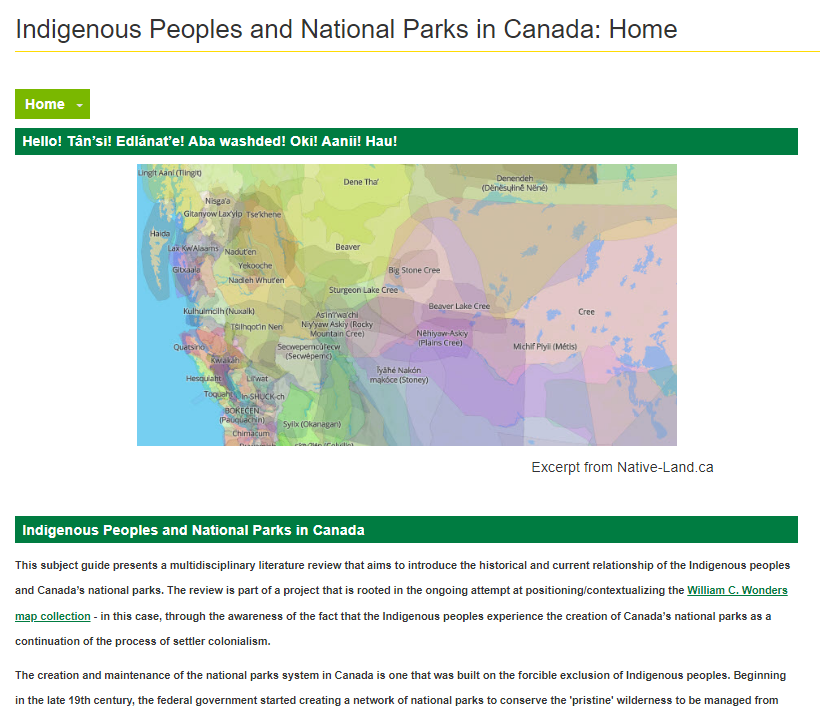
    A recent example of this is the Indigenous Peoples and Canada’s National Parks guide. This multidisciplinary literature review introduces the historical and current relationship of Indigenous people and Canada’s National Parks, and is part of ongoing work in re-positioning the WCW map collection. This literature review is part of a project that is rooted in the ongoing attempt at positioning/contextualizing the WCW map collection – in this case, through the awareness of the fact that Indigenous peoples’ experience the creation of Canada’s National Parks as a continuation of the process of settler colonialism. 

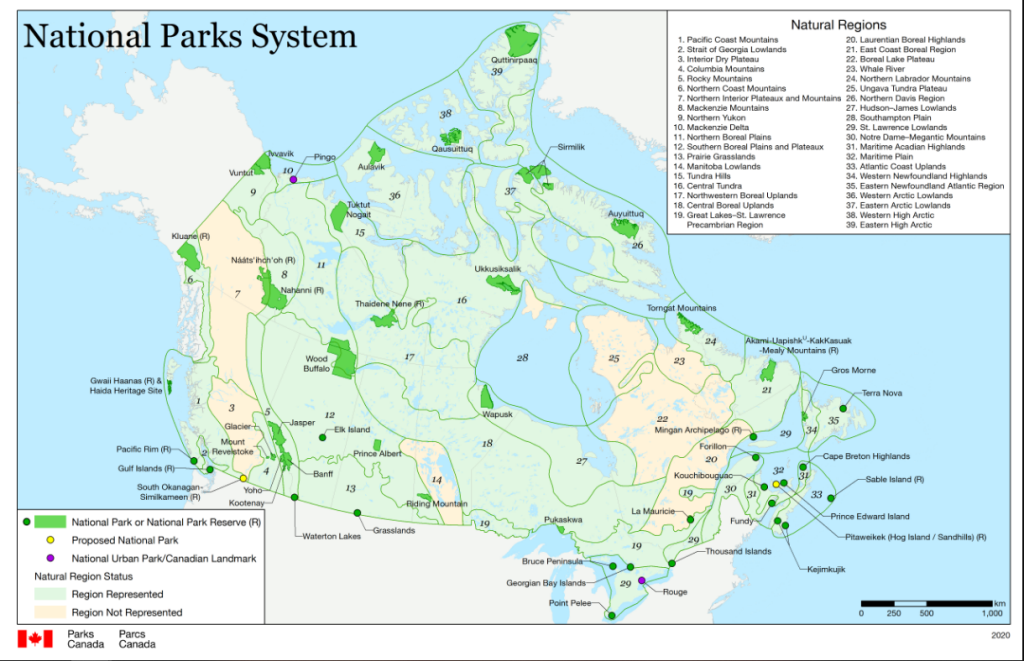
    The creation and maintenance of the national parks system in Canada is one that was built on the forcible exclusion of Indigenous peoples. Beginning in the late 19th century, the federal government started creating a network of national parks to conserve the ‘pristine’ wilderness, to be managed from Ottawa.  Many Indigenous communities were forcibly displaced within the newly-established park boundaries thereby disconnecting them from their traditional territories & resource management/rights.  New inclusionary paradigms, including co-management; Indigenous protected & conservation areas; and community based conservation, support the decolonization process through the promotion of Indigenous land governance, conservation and sovereignty.
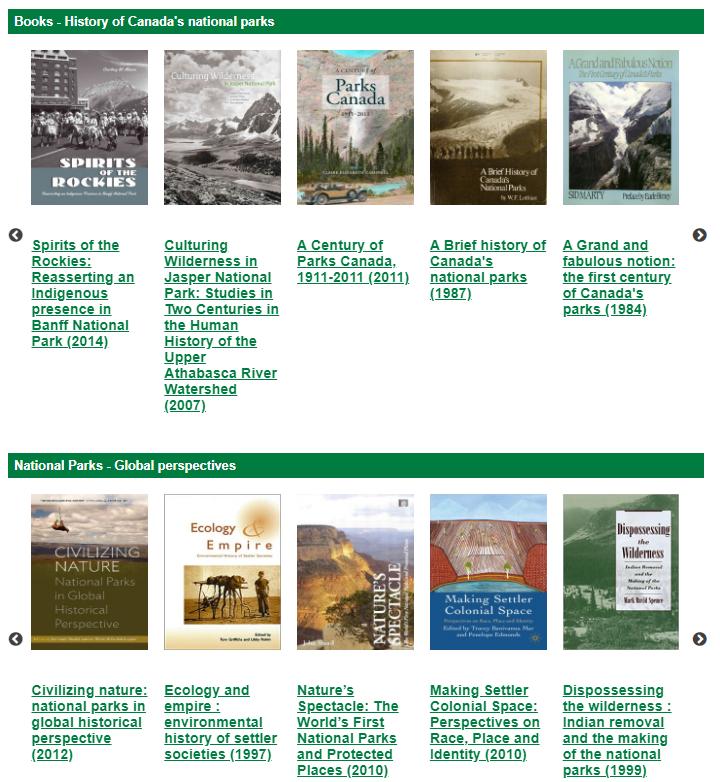
    The Indigenous Peoples and Canada’s National Parks guide breaks down the history of national parks in Alberta, in Canada and globally. It also introduces new paradigms on this topic.

    This guide points to reports and geospatial data on land boundaries as well as recent thesis and dissertations on this topic and provides a list of resources explaining Indigenous and counter mapping.
    Counter-mapping is a process of cartography that challenges the dominant views of the world and methods in cartography. It can allow for marginalized voices to communicate the stories and reveal the histories of their land.[1] In part 2 of this project’s story, we will elaborate on Indigenous people and counter mapping.

    The literature review and production of this guide was conducted by Bonnie Gallinger and Olesya Komarnytska.


    1. Vijayakumar, Shankeri. (2021, January 30) How counter-mapping helps reclaim Indigenous knowledges, land. The Varsity https://thevarsity.ca/2021/01/30/how-counter-mapping-helps-reclaim-indigenous-knowledges-land/
    0 comment
    1 FacebookLinkedinRedditWhatsappEmail
  • La Semaine de l’histoire du Canada 2022 se déroule du 21 au 27 novembre. La semaine encourage les Canadiens à réfléchir et à s’engager avec le passé du Canada. Qu’il s’agisse de vos personnages historiques préférés ou d’histoires cachées que vous n’avez jamais entendues, cette sélection de biographies et de mémoires vous ravira ! Ces livres racontent les événements qui ont façonné l’histoire du Canada en se plaçant du point de vue…

  • Welcome to World Hello Day 2022! Internationally observed on November, 21st, World Hello Day is recognized as a University of Alberta Day of Action in which we hope to extend the lines of communication and friendship across cultures, as well as build connections with one another. In 2021, our U of A Library blog provided some background on World Hello Day, with tips on how to make the most out of our…

  • This post was written by MACT student Joana Mazumder The Gourmand Awards, often compared to the ‘Oscars’ for the culinary industry, honours the world’s best food and wine books, print and digital, and food television. This year, a Canadian book titled, The High Protein Cookbook for Muscle Health During Cancer Treatment by Hillary Wilson, Anissa Armet, and Professor Carla Prado has won the Gourmand World Cookbook Awards 2022 for the University Press…

  • Après une interruption de deux ans, l’exposition “La couverture ne fait pas le livre” de la bibliothèque de l’Université de l’Alberta revient du 14 au 27 novembre 2022 ! “La couverture ne fait pas le livre” est un événement annuel organisé par la bibliothèque qui vise à mettre en avant les groupes sous-représentés. Afin de réveiller votre curiosité et de changer les présentoirs de livres réguliers, les livres sont emballés dans du…

  • After a 2 year hiatus, UAlberta Library’s Don’t Judge a Book By Its Cover returns Nov 14-27, 2022! Don’t Judge a Book by Its Cover is an annual event hosted by the University of Alberta Library that aims to shed light on underrepresented groups. As a twist on regular book displays, books are wrapped in brown paper and teaser keywords are written on the front. This wrapping symbolizes the marginalization of the…

  • This post was originally published in November 2020. On November 11 we will pause to honour the soldiers that have fought for Canada and to support the Canadian Troops. In addition to pausing for a day to honour the soldiers, I thought another way to appreciate the Canadian soldiers would be to showcase photos of the University of Alberta’s connection to World War I (WWI). With the help of our colleagues at…

  • La bibliothèque de l’Université de l’Alberta possède une collection assez vaste. Qu’il s’agisse de livres et de périodiques, d’articles de journaux, de vidéos et d’audio en continu, de kits divers, de jeux ou autres, les ressources à explorer ne manquent pas.  Néanmoins, nous devons parfois chercher plus loin et emprunter des documents à des bibliothèques extérieures au consortium NEOS. Nous appelons cela des prêts entre bibliothèques (PEB). Un PEB est la meilleure…

  • Hidden Gems: The New Yorker

    by Guest Author
    by Guest Author

    The University of Alberta Library subscribes to numerous resources that are core for certain disciplines, but also really deserving of wider attention. Here is one of those gems… For almost a century, The New Yorker has been a landmark source of modern literature. Short stories by noteworthy authors like Shirley Jackson, Philip Roth, Stephen King and Haruki Murakami, to name a few, have been featured in its pages. Writers working for the…

  • So you’re doing research and wondering if the University of Alberta Archives might have relevant materials.  Maybe you’re doing some family genealogy research and your Uncle Bob went to the University of Alberta, or perhaps your professor gave you a local history assignment that requires you to consult primary sources. How do you search the archives, anyways? The University of Alberta Archives (UAA) is the official repository for the permanently valuable records…