Le lundi, 30 septembre marque la Journée nationale de la vérité et de la réconciliation. À cette occasion, les services du campus, y compris la bibliothèque, seront fermés pour permettre aux étudiants et au personnel de se pencher sur les conséquences des pensionnats canadiens. Pour soutenir cette réflexion, la bibliothèque invite les étudiants et le personnel à participer aux activités suivantes.
Activité de perlage / du 24 au 27 septembre
Les broches en perles portées sur les chandails orange sont des symboles qui marquent l’impact des pensionnats sur les peuples autochtones du Canada. La Journée nationale de la vérité et la réconciliation est également connue sous le nom de Journée du chandail orange. Le symbole du chandail orange provient de l’histoire de Phyllis (Jack) Webstad, une femme Secwépemc (Shuswap) du Nord de la Première Nation Stswecem’c Xgat’tem (Canoe Creek Indian band). Phyllis a été forcée à entrer dans un pensionnat, comme l’ont été plus de 150 000 enfants autochtones pendant plus d’un siècle.
“À six ans, Phyllis est allée pour la première fois à son école au pensionnat de la mission St. Joseph. Elle portait un chandail orange tout neuf, cadeau de sa grand-mère (Kyé7e [QUE-A-AH]). On le lui a enlevé et on ne le lui a jamais rendu. “
(Orange Shirt Society. “Orange Shirt Society Resources” n.d. Orangeshirtday.org)
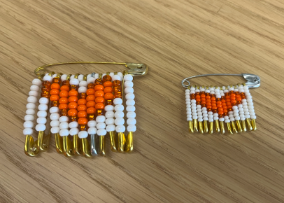
Au cours de la semaine précédant la Journée nationale de la vérité et de la réconciliation, la bibliothèque vous invite à créer une broche en perles pour mettre sur votre chandail orange.Vous pourrez ainsi passer du temps dans la bibliothèque à créer votre broche et à réfléchir aux conséquences des pensionnats canadiens sur les peuples autochtones. Le fait de se souvenir est un moyen de s’assurer que nous agissons pour mettre fin à la colonisation, et que les Canadiens qui ne sont pas autochtones ne commettent plus jamais de génocide culturel sur les peuples autochtones.
Pendant que vous vous asseyez pour faire votre broche, vous pouvez discuter avec d’autres personnes, lire les ressources que nous avons sur les pensionnats, ou réfléchir tranquillement aux moyens de répondre aux 94 appels à l’action de la Commission de vérité et de réconciliation du Canada.
Le modèle de broche a été créé par Felice Gladue, qui nous a permis de le partager. Vous trouverez le matériel pour l’activité de perlage aux bibliothèques Rutherford, Cameron, Saint-Jean , Augustana et Sperber.
Se connecter à l’art des survivants / 27 septembre 2024
Dans cet atelier organisé conjointement par l’équipe « Indigenous Initiative Team » de la bibliothèque et les musées de l’Université de l’Alberta, vous aurez l’occasion de vous plonger dans l’art visuel et les œuvres écrites des survivants des pensionnats autochtones.
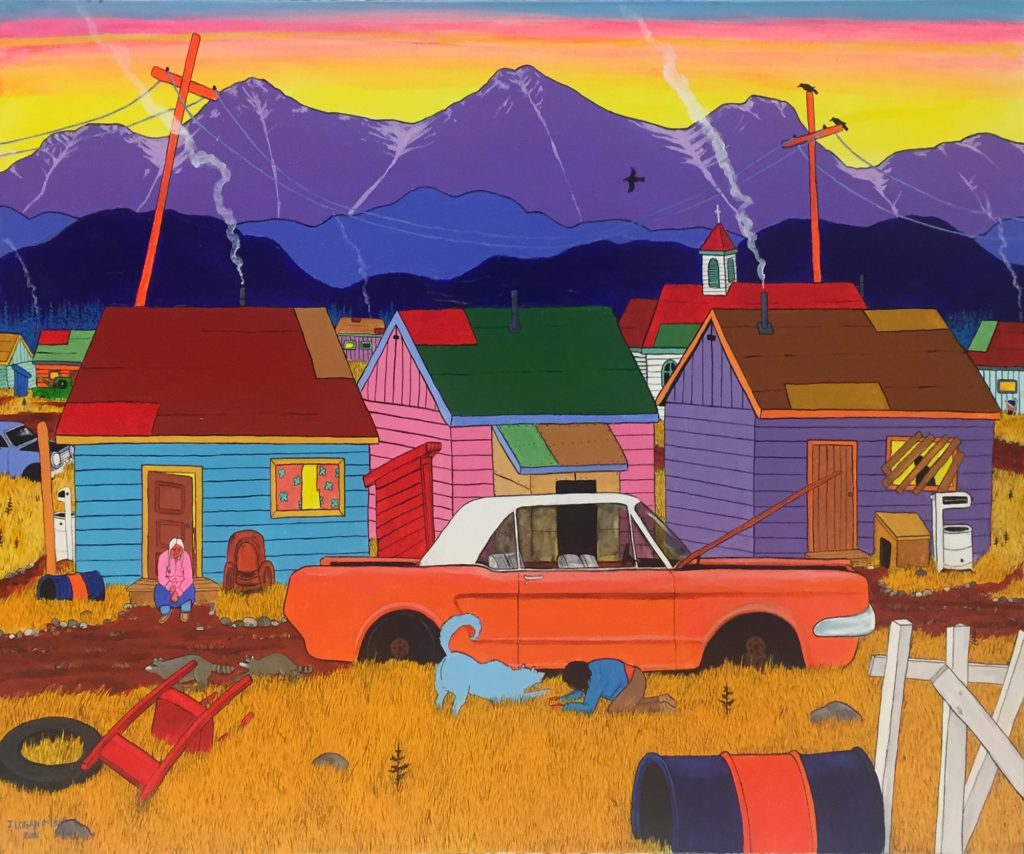
Where Did They Go?, 2018
Acrylic on canvas; painting / Jim Logan (born New WEstminster, British Columbia, 1955) / University of Alberta Museums Art Collection / University of Alberta Museums / 2021.2.2
Les collections de la bibliothèque et des musées contiennent plusieurs objets créés par des survivants des pensionnats qui ne sont pas nécessairement liés directement à leur expérience au pensionnat. Vous pouvez vous intéresser à ces œuvres en en apprenant davantage sur leur histoire et leurs créateurs, en établissant des liens entre elles et en comprenant votre propre relation à cette histoire commune.
Cet atelier offre la rare opportunité de découvrir en avant-première six nouvelles acquisitions d’œuvres d’art qui seront incluses dans la prochaine exposition, « on becoming ».
- Détails de l’inscription : Session du matin 10-11h30 / Session de l’après-midi 2-3h30 (27 septembre)
- Lieu : Print Study Centre dans le bâtiment des beaux-arts (FAB 3-78), Campus nord
- Il y a un maximum de 15 places disponibles par session.
Listes des ressources :
- Liste des Ouvrages pour la jeunesse à thématiques autochtones disponibles à la bibliothèque Saint Jean ou en ligne. Les ouvrages regroupent les livres présentant des caractères autochtones, traitent de l’expérience ou de vie des autochtones ou encore des sujets qui touchent les conditions des autochtones.
- L’équipe “Indigenous Initiatives” a créé une liste de ressources (en anglais) qui pourrait vous être utile – National Day for Truth and Reconciliation.
Cet article a été traduit par Elisabet Ingibergsson, l’original en anglais se trouve ici .
Ce contenu est placé sous une licence Creative Commons CC BY-NC-SA 4.0.