
Tag:

students

    Earlier this year LearnAlberta’s Online Reference Centre (ORC) ceased to exist. This meant the end of UAlberta access to resources like the Britannica Online School Edition K-12, PebbleGo and Gale Science in Context. Fear not, gentle educators and education students. Just because we no longer have access to these resources doesn’t mean there aren’t other options available to UAlberta folks. Our friends at Edmonton Public Library (EPL) have many resources related to early learning that current students, staff and faculty can access with their L-Pass.

    What’s an L-Pass? In a nutshell, your OneCard can be registered with EPL, enabling you to borrow items and access online resources available through their website. To register your OneCard as your L-Pass fill out this handy-dandy online form. The process is quick and once you’ve signed up your EPL access is instantaneous.

    For those interested in resources for young learners (and some of us not-so-young learners) here is a shortcut to find EPL’s trove of online resources, including many former ORC databases. Visit the A-Z Kids Resources section of EPL’s website. Some of the highlights include:
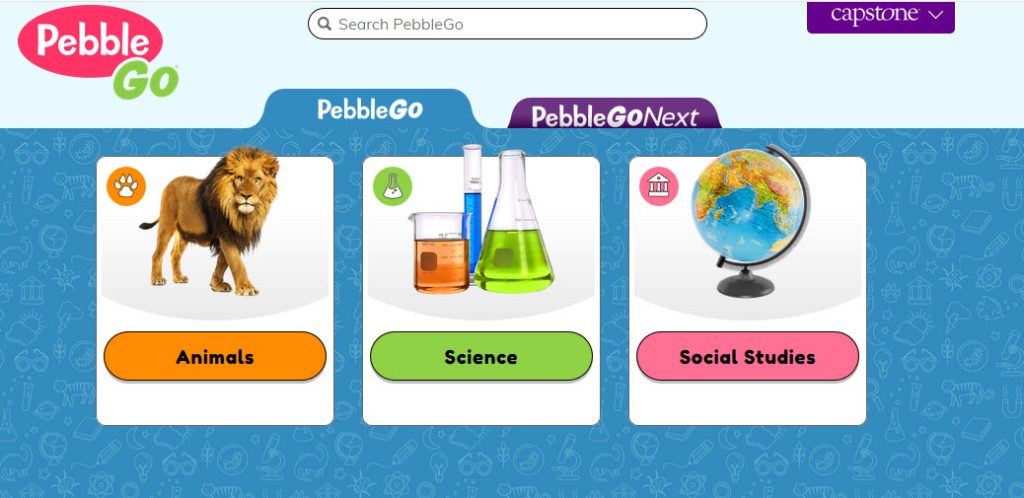
    PebbleGo’s Interface
    • Worldbook Encyclopedia Online
    • PebbleGo Animals
    • PebbleGo Science
    • PebbleGo Social Studies
    • PebbleGo Next Science
    • Bookflix
    • Canada in Context
    • National Geographic Kids
    • PowerKnowledge Life Science
    • PowerKnowledge Physical Science
    • PowerKnowledge Earth & Space Science
    • Teen Health & Wellness
    • Muzzy
    • Early World of Learning
    • Teen Book Cloud

    Thanks for the read! Like our blog posts? We invite you to subscribe to our newsletter (scroll down to the bottom right side of this page). Love us on the blog? You’ll love us on social media! Check us out at @uofalibrary on Instagram, & Twitter!

    0 comment
    1 FacebookLinkedinRedditWhatsappEmail
  • We’re celebrating Chinese culture this August, here on the Library’s news blog. Let’s kick things off with few fun facts about China and Chinese culture. We hope this inspires you to discover more interesting tidbits or do a deeper dive into aspects of China and Chinese culture. Here are a few subject guides to get you started. East Asian Studies Background Reference Resources Religious Studies There’s more to come on the blog…

  • Setting up a super study space

    by Eva Romanick
    by Eva Romanick

    As midterms approach, students are looking for a place to do some serious studying before exams or hunkerdown when writing their papers. We wanted offer some advice on how to create your own personal study space… We’ve got some tips and tricks to bring the studious atmosphere back to your home/dorm study space. Firstly, location, location, location… somewhere you can spread way out. You’ll need that room for your books, laptop and…

  • Seasoned Advice from Seasoned Pros

    by Junelle Mah
    by Junelle Mah

    Is hindsight the best sight? For staffers seasoned in the library sciences, the answer is yes! We polled our multi-disciplinary team of library whizzes and asked, “What one library resource did you wish you knew about/had access to when you were a student?“ Almost immediately, David Sulz (Academic Librarian) replied back with the Oxford English Dictionary. While our holdings include physical copies, the most up-to-date edition is our online version. It contains…

  • What is a citation management system? Why is it important? What does UA provide? Is it meeting the needs of our users? In order to find out we need your feedback. Citation management is an essential component of scholarly communication and research processes. These processes are constantly evolving in response to ongoing changes in disciplinary contexts, technology, standards and best practises, and funding opportunities. Citation or Reference Management Systems (RMS) are the…

  • Data Physicalization

    by Guest Author
    by Guest Author

    Written By Abbie Schenk When we think of data visualizations, we often think of charts, maps and other forms of expressing data in digital ways. But humans have visualized data for thousands of years, long before computer screens were invented. Some of the earliest data visualizations go back to 5500 BC when Mesopotamians used clay tokens to visualize data. Today, representing data in a physical manner is called data physicalization. The Digital…

  • Are you the type of person  who constantly has music on in the background? Do you play an instrument or have an interest in music theory or history? Do you like diving through the unknown corners of the digital space in search of a hidden musical jewel? If the answer is yes to any of these questions, what you find below will be the ticket to your next great musical journey!  The…

  • Have a GOOD Friday

    by Eva Romanick
    by Eva Romanick

    April 10th is Friday, and what a GOOD FRIDAY it is! We’re here for you while you stay home… Make your morning java a LARGE before settling in for a good longform read from The New Yorker! Stretch break! Pop into Anatomy.tv to explore the human body… take navel-gazing to a whole new level! Studying at home is not the same. Tune into a library ambience track for students who work better surrounded by…

  • Since the majority of us are stuck inside and online, we all have to find ways to work, learn, stay connected, shop, exercise or entertain ourselves… well… online. Even though the internet has been part of our world for a while now, and most of us take advantage of it already, ‘social distancing’ has resulted in significantly more time spent in front of our screens and a higher demand for quality streaming…

  • With the majority of students and staff being advised to work and study from home, this is how our librarians are supporting online learning… How do you train an animal on a farm? What does its habitat look like, and how does it play? These are just some questions that an ALES class needs to answer for an assignment in this new, all-virtual, learning environment. They need to pick an animal species…