
Digital Collections

    Last month, with the help of colleagues, I created a new Wikipedia page for the Henderson’s Directories! This was a project that combined two areas of my work that I never imagined could meet!
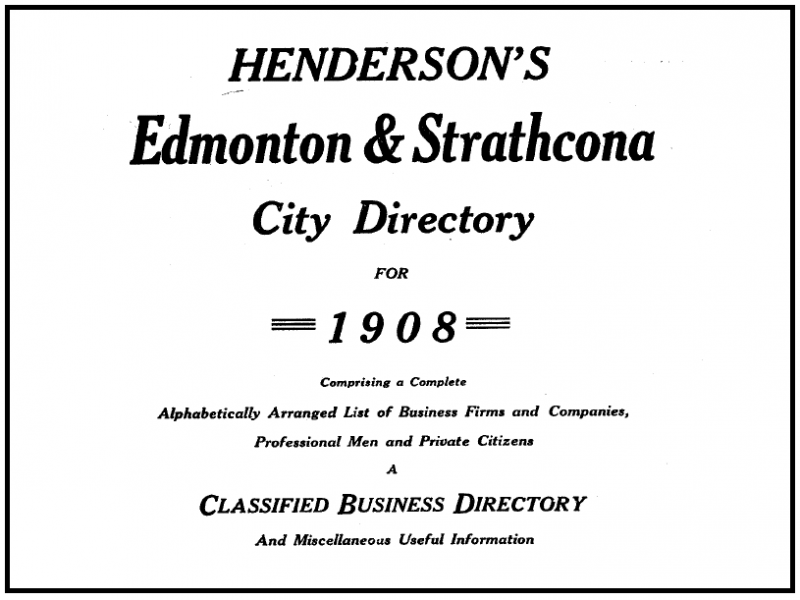
    Title page of the Henderson’s Edmonton & Strathcona City Directory for 1908.

    City Directories 

    City directories were once commonplace. In the late-18th and early-20th centuries, they helped people navigate cities and find residents & services. Today, they give us a glimpse into everyday life in the somewhat-distant past. I think of them as pre-telephone phone books, which are also rapidly becoming a relic of a the slightly-less-distant past!

    Henderson’s were published across many cities in Western Canada, including Edmonton. Here at the U of A Library, we’ve digitized many volumes of Henderson’s, and we help people use them all the time. They have become an  invaluable resource for local historians, genealogists and curious folks looking into their houses’ past.

    But for someone completely new to city directories, it’s really hard to figure out what it even is. In its digital format, Henderson’s are no longer big thick volumes, easy to flip through like a dictionary. There are often pages upon pages advertisements, before you can even find a title page.

    To help introduce the concept to new users, I wanted to create a simple introduction, and Wikipedia seemed like a good starting place!

    Delving into Wikipedia

    I call myself a Wikipedia “newbie”, but it’s not really true. I’ve been reading it for just about as long as I’ve been on the internet. Like many people, it’s my first-stop whenever I encounter a new concept.

    The idea of actually contributing to the giant online encyclopedia didn’t really occur to me until I worked with our Wikipedian in Residence.

    I’m still a very new Wikipedia contributor. I had attended 3 Wikipedia workshops before getting up the courage to do anything! It’s a little intimidating, knowing how far the reach of Wikipedia is. But Henderson’s was something I really wanted to do; and once I got started, it didn’t take me long to get comfortable with the act of editing.

    Edit Bravely

    If you’re reading Wikipedia and notice a mistake, or something missing, I encourage you to fix it. You don’t need to be an expert or be familiar with all the guidelines—in fact, Be Bold is one of the central principles.

    If you want to edit with a community, there are lots of cool collaborative projects going on, such as Art+Feminism. I want to especially highlight the projects aimed at countering systematic biases within the encyclopedia. 

    Edit boldly, and don’t be afraid of making mistakes—someone will likely correct it very quickly!

    Discover the Henderson’s Directories

    2 comments
    2 FacebookLinkedinRedditWhatsappEmail
  • The University of Alberta Library subscribes to numerous databases that are core for certain disciplines, but also really deserving of wider attention. Here is one of those gems… Royal College of Physicians: A Wiley Digital Archives Collection primarily relates to the history of medicine, but others may also enjoy exploring this fascinating database! This digitized archival collection contains the documentation of the Royal College of Physicians (RCP). The RCP came into being…

  • PRIDE 2021: MOVIE RECOMMENDATIONS

    by Guest Author
    by Guest Author

    Written by our guest author: Natalya Brettle Most of us grow up loving movies.  Film is an immersive form of storytelling that engages our sense of sight, sound and sometimes even touch (vibrating seats, anyone?). These stories can be both an entertaining escape from daily life and a cultural touchstone that reflects our realities.  On the other hand, popular film making hasn’t always widened its lens to offer up much variety when…

  • Hidden Gems: Ethnologue

    by Eva Romanick
    by Eva Romanick

    The University of Alberta Library subscribes to numerous databases that are core for certain disciplines, but also really deserving of wider attention. Here is just one of those gems… Ethnologue: Languages of the World primarily relates to Modern Languages and Cultural Studies, Teaching First Nations, Métis and Inuit Languages and everything Linguistics. Explore your mother language, your mother’s mothers language and others, in this comprehensive guide. Thousands of languages are spoken today.…

  • Understanding the past is a powerful way to help keep it from repeating in the future. In trying to be a better ally to those in the Black community, I’ve found it particularly enlightening to learn and understand the fraught road towards equity and civil rights, which is sadly still being traversed. If you’re like me and seek to understand how we have gotten to this point we have some resources for…

  • Hidden Gems: The Teaching Professor

    by Eva Romanick
    by Eva Romanick

    The University of Alberta Library subscribes to numerous databases that are core for certain disciplines, but also really deserving of wider attention. Here is one of those gems… The Teaching Professor may be best known to those in Education. But, the changes brought about by the pandemic have prompted more people than ever to think about how to teach well and create great learning opportunities. From the Library catalogue link, click on…

  • New Archives Website

    by Meredith Bratland
    by Meredith Bratland

    The University of Alberta Archives website has been overhauled and redesigned. It’s looking fabulous, if we do say so ourselves! With the new website, users will be able to: easily search the archives collection from the homepage search bar, read FAQs to help you prepare for a visit to the archive, and discover the Archives Digital Collections hosted on ERA (UAlberta’s digital repository) and the Internet Archive. We hope you enjoy the…

  • Hidden Gems: Birds of the World

    by Eva Romanick
    by Eva Romanick

    The University of Alberta Library subscribes to numerous databases that are core for certain disciplines, but also really deserving of wider attention. Here is just one of those gems… Birds of the World is primarily considered a Sciences database. But you don’t have to be a scientist, or a Birder, to use it! “Every bird has a story – Take a deep dive into the remarkable lives of birds with this dynamic…

  • Taking 2020 Back From the Pandemic

    by Sonya Leung
    by Sonya Leung

    This year the University of Alberta’s Winter Closure will span from December 25, 2020 to January 3, 2021. Here is where you can find dates of closure and resumption of our library services. PANDEMIC — is the word that defines the year 2020. I know I am not alone when I say this year has been HARD. That is why I propose that we take the 10 days of Winter Closure as…

  • Hidden Gems: ArtStor

    by Eva Romanick
    by Eva Romanick

    The University of Alberta Library subscribes to numerous databases that are core for certain disciplines, but also really deserving of wider attention. This is one of those gems… Artstor is a collection of more than a million high-quality digital images of works of art from the collections of galleries, museums, and libraries around the world. It is used most often by researchers in the Arts and Human Ecology: Clothing, Textiles & Material…