Community

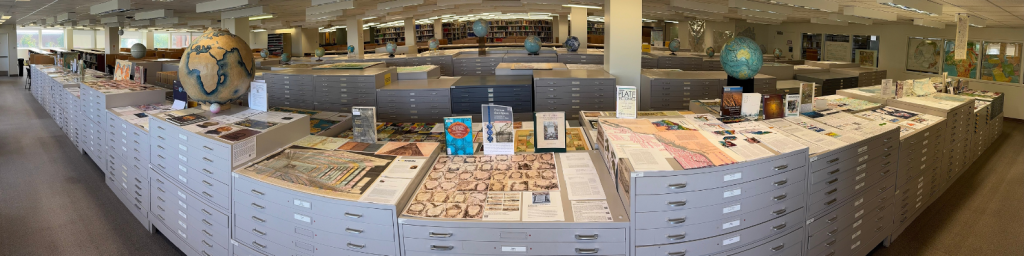
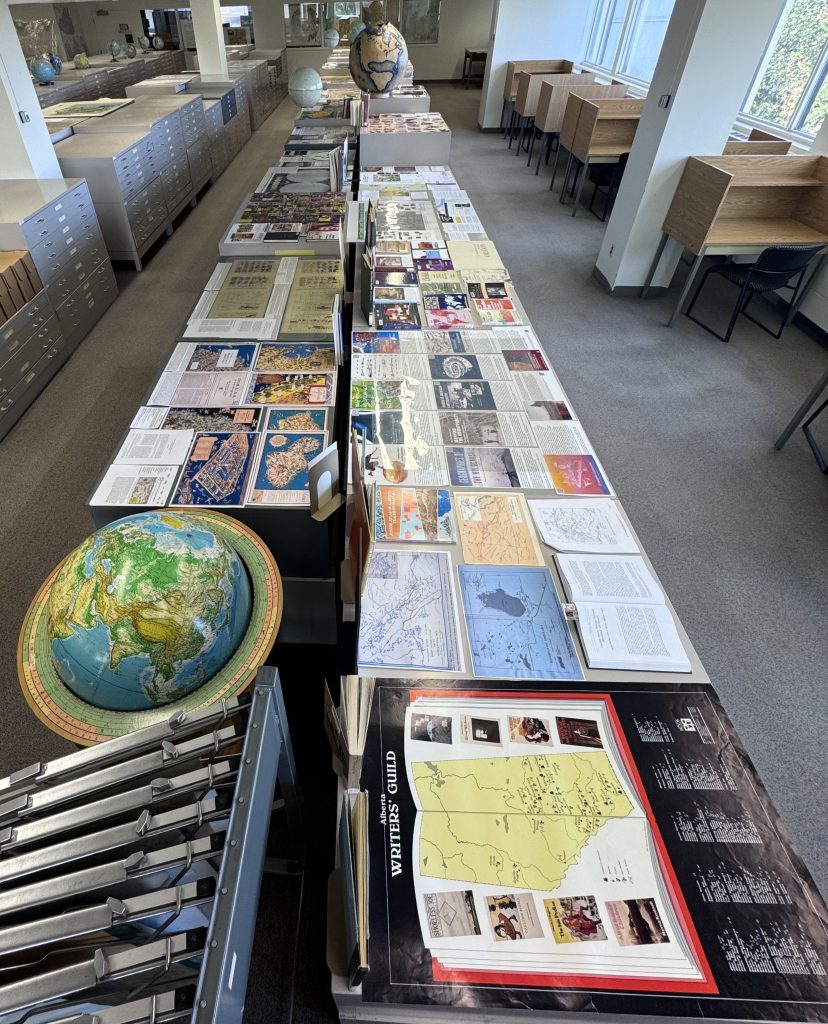
    This past May, Larry Laliberte, GIS/Maps Librarian, and Bonnie Gallinger Information Services & Maps Specialist curated a unique map exhibit on the 4th floor of Cameron Library; the exhibit was built day by day for 31 consecutive days in the month. Thank you to Larry and Bonnie for writing this guide to the exhibit. We invite you to take some time this summer to explore and engage with these fascinating items on display on the map cabinets. 
    There was a time. 

    A temporal splay, before we collectively entrusted our soles to the GPS embedded in our phones, that to traverse point-to-point between place-to-place, folk had to ever and anon ask for directions. Even more, they were oft-obliged to remember lengthy depictions that contained roundabouts, switchbacks, and landmark plot twists. 

    Consider what follows such a tale-o’-the-trail. So let’s attire in spatial troubadour, and dismiss those saturated satellites that Billy Bragg once wished upon.

    Navigating to Cameron Library 4th Floor

    Entering Cameron Library, and facing the Service desk you are pointed East. Keep moving, but don’t forget to give an acknowledging smile, to the individuals who, with composure and forbearance, engage with library patrons daily. Once you arrive at the East stairs, and elevator, the expedition gets vertical. Climbing over contours, and ascending heights of land you portage to the fourth floor.
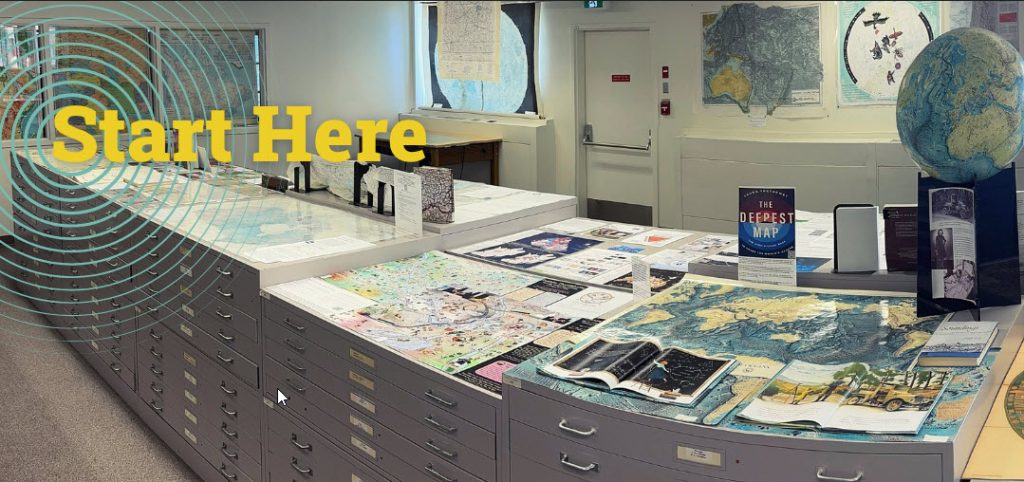
    Navigate to the North West cabinet that faces South, the fluxatlas[:] awaits.

    As you enter the floor, perform a left shoulder check if you see a space entitled “Donor Wall” containing a 1921 map titled “The Dominion of Canada & Newfoundland. You have rhumblined a correct course and can now pivot to the right. Continue your journey to the North shore of the fourth floor where a wrack line of quarter sectioned map cabinets are arranged under a North West moon that filters natural light. Navigate to the North West cabinet that faces South, the fluxatlas[:] awaits.
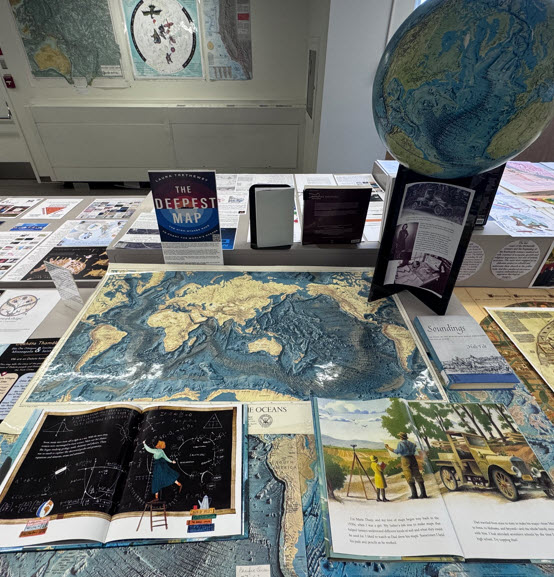
    Open the first drawer that surmounts Gibraltar, take a directional bookmark (or two), and, if at any time you have a comment, thought, or if inclined, a spatial poem, write it down while aligned with your bookmark to the North, South, East or West. Also, scoop up one of the “Meet the Map” index cards that provide useful prompts to situate, and better comprehend the maps you will encounter. By using “Meet the Map” you can shift from discovery and investigation to interrogation. In keeping with the floor’s official silent designation, in quiet contemplation absorb the spatial collage entitled “Map a-day-in May (a thirty-one cabinet display)”. Slow your pace, jettison the hectic, beguile a while amongst the tactile and visually absorb a wunderkammer of maps, images, articles, books, atlases and if seeking further information scan those utilitarian QR codes that tether you back to the virtual realm. Follow the map cabinets East. At the map cabinet terminus and just past the hanging 3-D plastic relief models perform a U-Turn, and then head Westward where Narnia awaits.
    • Were there maps that caught your eye, surprised you?
    • Maps and their stories that were uplifting and/or upsetting?
    • Were there cartographers, artists and researchers we missed?
    • If you were to curate a map cabinet top, what spatial display would you conjure?

    Share your answers to these questions and your feedback about this display with Larry Laliberte, GIS/Maps Librarian at data@ualberta.ca

    This content is licensed under a CC BY-NC-SA 4.0 Creative Commons licence.

    0 comment
    25 FacebookLinkedinRedditWhatsappEmail
  • To mark Indigenous History Month, we are shining a spotlight on our Indigenous Healing Collection situated on the main floor of the Geoffrey + Robyn Sperber Health Sciences Library. This collection encompasses works about the peoples of the land now known as Canada, as well as those from regions where Indigenous cultures were overshadowed by processes like colonization. There is more information about the scope and focus of the Indigenous Healing Collection…

  • We’re thrilled to celebrate the accomplishments of our incredible student library staff graduating this year. These talented individuals have balanced their studies with their roles at the University of Alberta Library, immensely contributing to the university community through their skills, hard work, and enthusiasm.  To celebrate their achievements, we asked our graduating student library staff to reflect on their time at the University of Alberta Library, share their proudest moments, and offer…

  • Congratulations to all U of A graduate students who submitted their work to our 2025 Images of Research (IOR) Competition and Exhibition! This annual event, which is a collaboration between the U of A Library and the Faculty of Graduate and Postdoctoral Studies, welcomed 69 submissions that allows students to depict their research in a single image. Our panel of judges narrowed the field to 24 semifinalists, our People’s Choice vote was…

  • The University of Alberta Archives is proud to join a global movement for accessibility by being represented linked on the International Council on Archives’ #ArchivesAreAccessible Map. This demonstrates our dedication to ensuring archives are open, inclusive, and available to all. In honour of International Archives Week June 9-13, 2025, we invited Amy Kamel to share her reflections of her work at the University of Alberta Archives as a Student Assistant.  A daydreamer…

  • Discussion of chronic diseases such as high cholesterol, heart disease, and diabetes, has been brought to the forefront recently. What is the correlation between the health of your gut microbiome, an industrialized diet, and chronic illnesses? What can the average person do to avoid chronic illness? Could the answer be found in our food? New Open Education ebook Dr. Anissa Armet, a postdoctoral researcher at the University of Alberta, and Dr. Jens…

  • À l’occasion du Mois de l’histoire autochtone, nous mettons en lumière notre collection sur les méthodes de guérison autochtones, située au rez-de-chaussée de la bibliothèque des sciences de la santé Geoffrey + Robyn Sperber. Cette collection comprend des ouvrages sur les peuples du territoire aujourd’hui connu sous le nom de Canada, ainsi que des ouvrages provenant de régions où les cultures autochtones ont été éclipsées par des processus tels que la colonisation.…

  • The University of Alberta is over one hundred years old. Have you ever wondered how our campus changed during the world wars? When we welcomed our first international students? What secret histories our departments, buildings, and clubs hold?  Luckily, we have an archive to answer all these questions and more. The University Histories Archive collects documents from all walks of campus life, from books written by our first official historian (did you…

  • What better way to immerse yourself in Asian Heritage Month than through the captivating lens of Asian cinema? Here’s a selection of films that showcase or are created by the Asian community. So grab your popcorn and join us on a cinematic journey. National Film Board (NFB) The NFB have a curated selection of films that celebrate the many achievements and stories of Canadians of Asian descent: Asian Communities in Canada Looking…

  • As we’re nearing the end of final exams, it’s the perfect time to pause, reflect, and celebrate all that we’ve accomplished together this academic year at the University of Alberta Library. From busy study spaces to innovative research support, our library locations have been alive with activity—and it’s all thanks to you, our community of students, faculty, staff, alumni, and researchers. The numbers speak for themselves, painting a picture of how deeply…