
Congratulations to ISTL: Issues in Science & Technology Librarianship, for publishing their 100th issue this month!
With its first issue published way back in 1991, ISTL was an early adopter of the electronic publishing medium. Back then, they were distributed using simple text files, and used ASCII art to represent the logo of STS (Science and Technology Section of the American Library Association)!

Over the years, ISTL’s format evolved into HTML and PDF files, which they hosted on their own website.
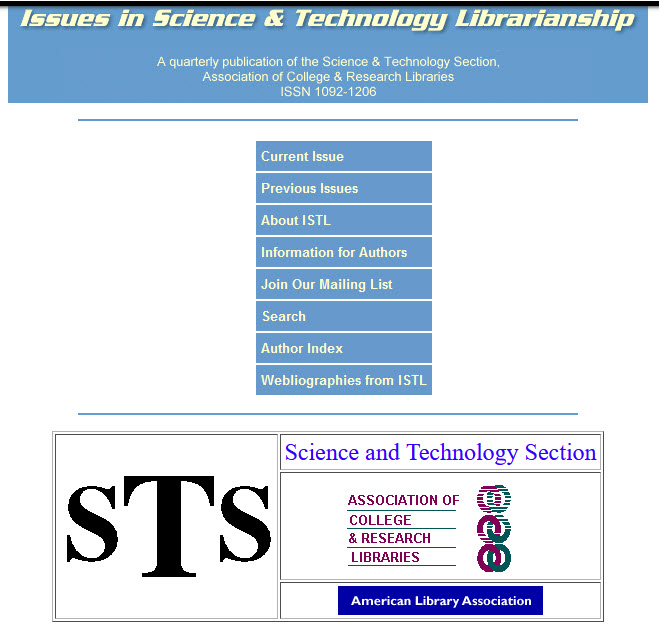
Moving to OJS & University of Alberta Library publishing program
In 2019, ISTL decided to migrate their journal to the University of Alberta Library, where they would use OJS (Open Journal Systems) software to edit and publish their content.
ISTL’s old journal website had a simple HTML structure so the move to OJS meant they could do all the editorial work within the publishing platform. Also, they are now working in a database-driven system that offers structured metadata.
Structured metadata means that information about the articles can be bundled up in a variety of different ways, making it compatible with other systems. As a simple example: dates can be displayed as 2022-09-01 or September 1, 2022. Structured metadata also allows for great access through indexing – if you’ve ever used a filter to narrow down your search results, you’ve already encountered a benefit of structured metadata!
As you can imagine, migrating nearly 30 years of back issues was a huge and challenging project, with hundreds of files to reformat. With the help of our incredible technical support team, dedicated editors from ISTL who checked the articles for quality, the 90+ issues were migrated to the new platform. The project took over 2 years to complete – just in time for the 100th issue!
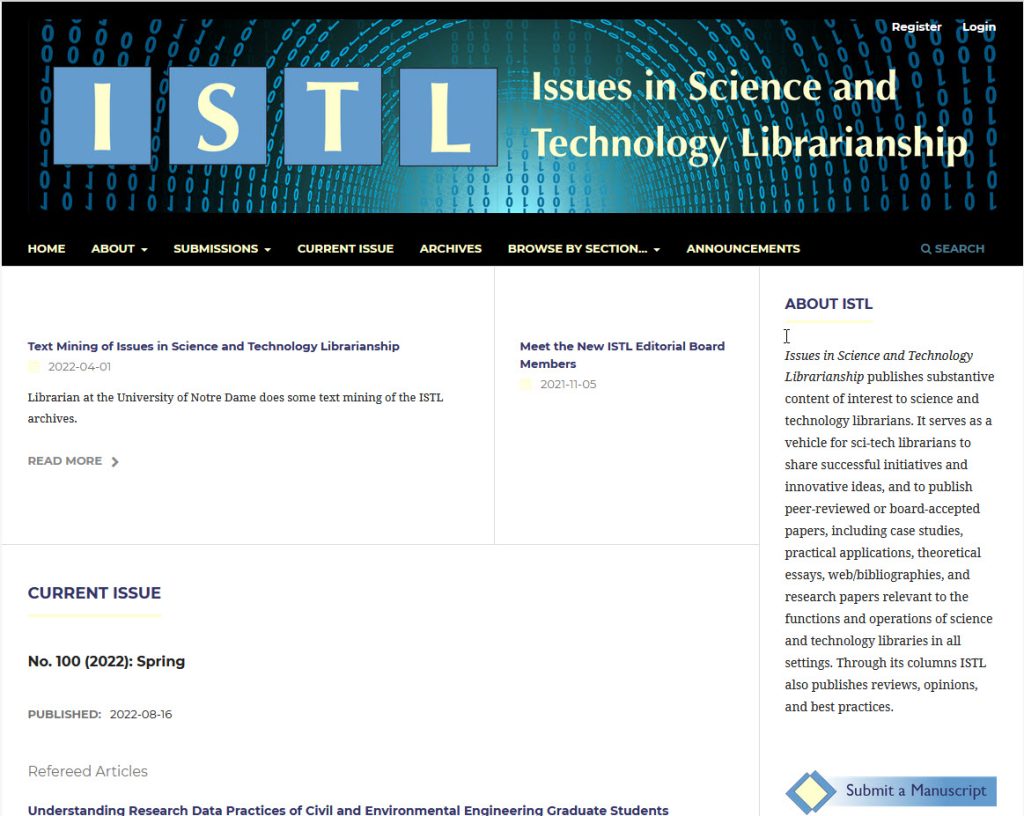
Visibility through Interoperability
Publishing open access on OJS opens up a journal’s content in often-unimaginable ways: reaching different types of researchers and allowing for research methods, like text mining.
OJS uses OAI-PHM, which is defined as:
The Open Archives Initiative Protocol for Metadata Harvesting (OAI-PMH) is a low-barrier mechanism for repository interoperability. Data Providers are repositories that expose structured metadata via OAI-PMH. Service Providers then make OAI-PMH service requests to harvest that metadata.
Open Archives Initiative
In less tech-y words: interoperability means that electronic systems can successfully “talk to” each other. Data can be moved from System A by System B, while maintaining its meaning and readability.
Example Research Project
This researcher, Eric Lease Morgan, used OAI-PHM to harvest ISTL content and apply text mining research methods to study librarianship. The researcher was easily able to take 900 articles’ worth of metadata out of OJS and put it into a spreadsheet in 30 minutes. Then they downloaded all the files into 1 place with relative ease.
Once this dataset is compiled, researchers can perform computer-assisted text analysis (e.g. figure out what the most frequently-used keywords were), and then present findings through data visualization (e.g. charts, word clouds, etc.).
When computer systems can communicate with each other, neat research like this can be done way more efficiently!
If you’d like to learn more about the Library Publishing program, please visit us at the Library Publishing Webpage or contact library.publishing@ualberta.ca!