Search results for

"images of research"

    Have you ever wondered how local political ads have evolved? Or explored historical newspapers to find old relatives’ bowling groups, or marriage announcements? Have you enquired about the cost of a gallon of milk in your town in 1965? Questions like these arise when considering the significance of newspaper digitization.

    The Drayton Valley Newspaper project

    The Drayton Valley Newspaper project began in 2023 when Sandra Blades of the Drayton Valley Museum contacted the library. They informed us that they had copies of Drayton Valley’s local newspaper, The Western Review going back to 1956, about a year after its initial publication by Leanord Hogarth 1. The project has undergone many stages and digitized copies from 1965-1972 are in the process of being added to the library’s Internet Archive collection. Let’s discuss the Drayton Valley Newspaper project as a way to understand the digitization process.
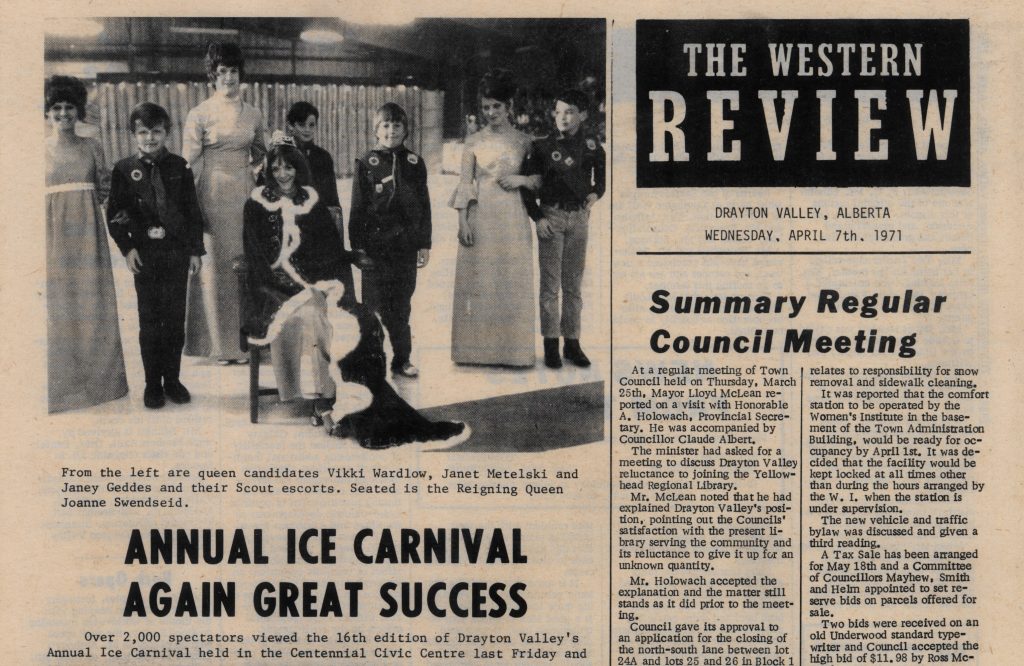
     Front page of The Western Review (April 7th, 1971)

    We wanted to make these newspapers accessible to read as Internet Archive flipbooks. A flipbook is a mode of reading digitally that appears and operates like a physical book (here is an example from the Edmonton Queer History collection). In order to be readable as a flipbook, the images needed to be altered. This is because they were scanned as one image consisting of two pages of the newspaper. 
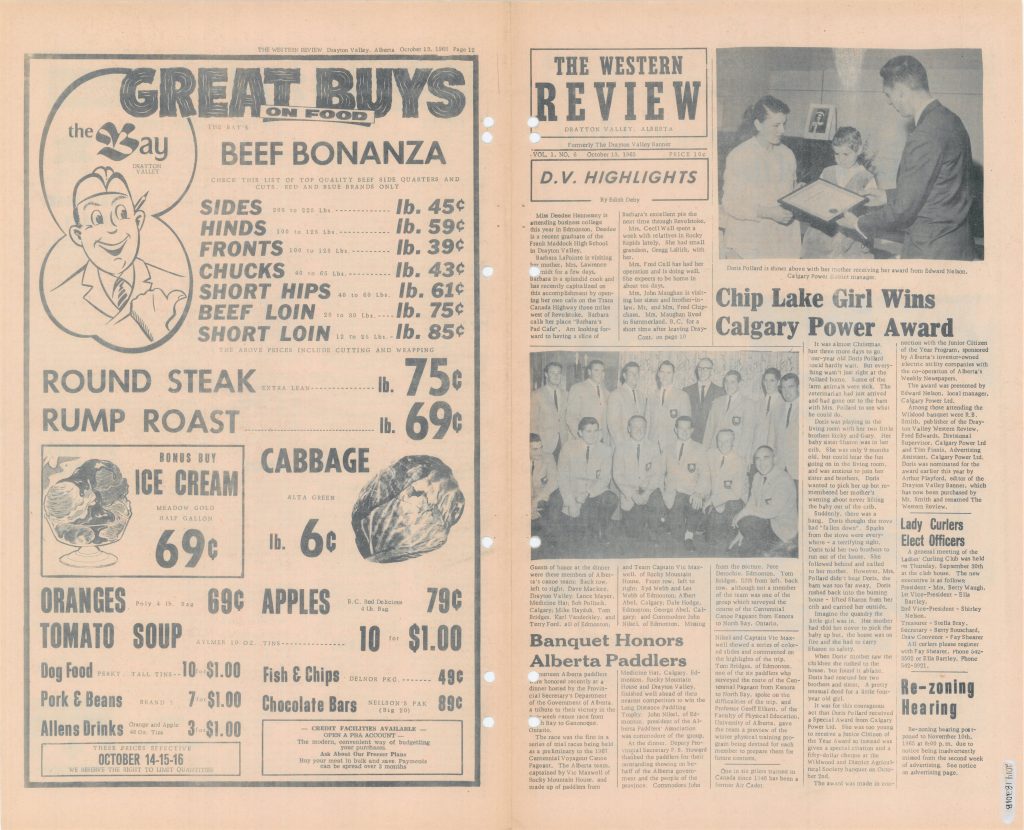
    Pre-split pages 12 and 1 of The Western Review (October 13th, 1965)

    While it was possible to manually edit these images using photo editing software, it seemed most efficient to use Python’s image editing capabilities. Python, a versatile computer programming language, allowed us to automate this process. For this project, I wrote a script that navigates to the center point of each image and splits it into two separate images. 

    This was not the only challenge to be tackled using Python because not all issues had the same page numbers. Therefore, not every newspaper we had scanned was ordered in the same way. This meant we needed to create different scripts that would correctly label the page number of  each image. Python proves to be a useful language for expediting library tasks, including digitization.
    Unexpected perks of the digitization process

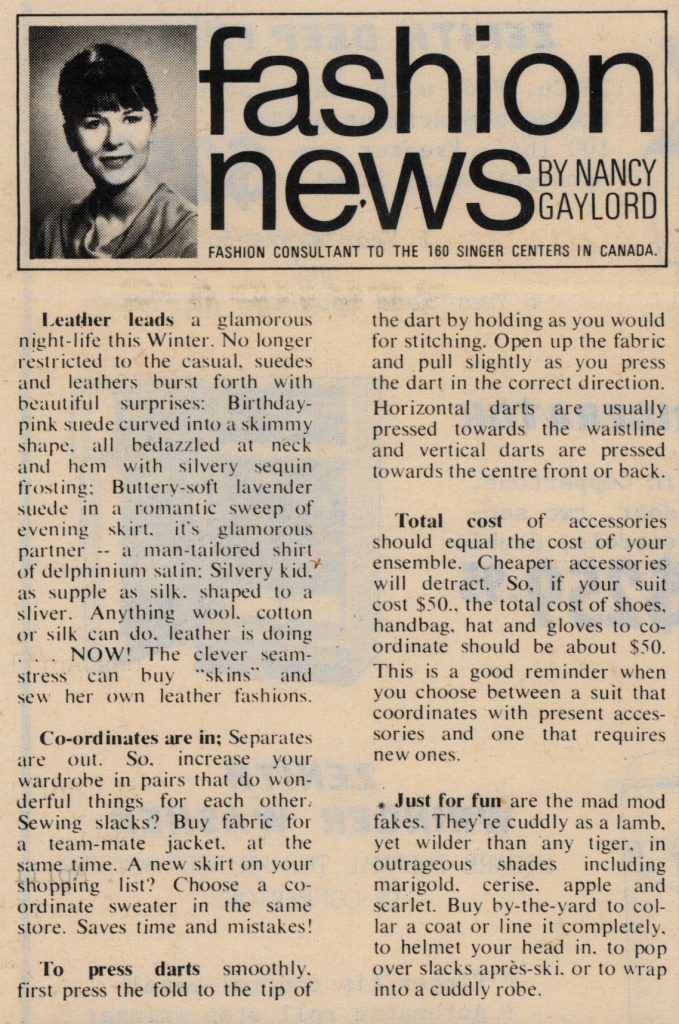
    This process meant I had the joy of getting to read some of these newspapers while splitting the images. What was particularly fun to watch evolve was the styling of the fashion ads as the paper emerged from the 60s into the 70s. I became quite a fan of fashion consultant Nancy Gaylord’s “Fashion News”, which included helpful tips for readers. On a personal level, the Western Review taught me how to press pants, but on an academic level there are all sorts of angles researchers can take!

    What has been particularly fun about this project is the opportunity to collaborate with community partners. This project was initiated by members of the Drayton Valley Museum through our project proposal document available on the Digitization page of the library website, which is open to members outside of the university. Something I love about working with digitization services at UAL is that we have this opportunity for community collaboration and impact.

    Next Steps

    The digitization process can take time; this project, for example, is years in the works. The next step for this project is uploading, and due to the high-quality nature of our images, uploading takes time and is often completed in batches. Keep an eye on our Internet Archive page where issues of The Western Review can be accessed. Subsequent papers have plans to be digitized and made available after this initial project. Hopefully, your interest has been piqued and you will look out for Drayton Valley’s The Western Review on our Internet Archive repository this summer!

    Thank you to Dana Villareal, Student Digitization Assistant for submitting this article!


    1 Gloria M. Strathern, Alberta Newspapers, 1880-1982: An Historical Directory (Edmonton, AB: University of Alberta Press, 1988), 75, 342.

    This content is licensed under a CC BY-NC-SA 4.0 Creative Commons licence.

    0 comment
    5 FacebookLinkedinRedditWhatsappEmail
  • This past May, Larry Laliberte, GIS/Maps Librarian, and Bonnie Gallinger Information Services & Maps Specialist curated a unique map exhibit on the 4th floor of Cameron Library; the exhibit was built day by day for 31 consecutive days in the month. Thank you to Larry and Bonnie for writing this guide to the exhibit. We invite you to take some time this summer to explore and engage with these fascinating items on…

  • The University of Alberta Archives is proud to join a global movement for accessibility by being represented linked on the International Council on Archives’ #ArchivesAreAccessible Map. This demonstrates our dedication to ensuring archives are open, inclusive, and available to all. In honour of International Archives Week June 9-13, 2025, we invited Amy Kamel to share her reflections of her work at the University of Alberta Archives as a Student Assistant.  A daydreamer…

  • The University of Alberta is over one hundred years old. Have you ever wondered how our campus changed during the world wars? When we welcomed our first international students? What secret histories our departments, buildings, and clubs hold?  Luckily, we have an archive to answer all these questions and more. The University Histories Archive collects documents from all walks of campus life, from books written by our first official historian (did you…

  • Did you know there is a state-of-the-art Media Lab in the Sperber Health Sciences Library? It is a bookable space for students, staff, and researchers for all audio and video recording projects. We’d like to highlight an exciting student use-case where the crew of three students (Jashan, Yuvraj, and Arpit) created Behind the Labs, a podcast that focuses on breakthrough research studies and their real-world implications to make it easy for people…

  • Edmonton Queer History Collection

    by Guest Author
    by Guest Author

    The University of Alberta Library continues to add to our openly accessible digital collections. We are excited to share the latest additions to the Edmonton Queer History Collection. This collection includes 2SLGBTQ+ community magazines, newsletters, and items of historical significance and is made possible through our ongoing partnership with the Edmonton Queer History Project and MacEwan University Archives.  New Additions  This new batch includes significant materials that highlight the rich and diverse…

  • Student Journal Spotlight: Crossings 

    by Guest Author
    by Guest Author

    The University of Alberta Library publishes 19 student journals as a part of its Open Publishing program. These journals are founded and run by student editorial boards, and typically publish work written by fellow students.  One student journal is Crossings: An Undergraduate Arts Journal. Since 2021, Crossings has published work by University of Alberta undergraduates in the fine arts, social sciences, and humanities. Crossings’ parent organization is OASIS, the Organization for Arts…

  • Hidden Gems: Stream with Alexander Street

    by Eva Romanick
    by Eva Romanick

    The University of Alberta Library subscribes to numerous databases that are core for certain disciplines, but also really deserving of wider attention. Whether for class or for a bit of break, check out a selection of our most popular streaming services. Alexander Street  publishes many video-only databases that are listed here separately, but this link brings all of those collections together on a single platform.  Click on ‘Collections’ to see a complete…

  • Today we are having a look at books that explore time (and our relationship to it). We invited colleague Brett Sheehan, Student Information Services Assistant and University of Alberta student in Library and Information Studies, to share these book suggestions drawn from a book display he curated at Rutherford Library last year (or was it? – time flies).   Brett: From the start, I wanted to look into our library’s science fiction collection.…

  • Hidden Gems: Stream with Kanopy

    by Eva Romanick
    by Eva Romanick

    The University of Alberta Library subscribes to numerous databases that are core for certain disciplines, but also really deserving of wider attention. Whether for class or for a bit of break, check out a selection of our most popular streaming services. Kanopy is a large collection of films from sources worldwide including documentaries, training films and theatrical releases. This streaming database offers professors, researchers and students access to a large variety of…